2026 Art + Technology Lab Grant Recipients
The Art + Technology Lab at the Los Angeles County Museum of Art (LACMA) is pleased to announce its 2026 grant recipients.
The 2026 grants introduce a new structure for the program. With renewed support from Hyundai Motor Company, the Lab will support new cohorts of artists every two years. The longer grant period encourages deeper collaboration, sustained artistic development, and increased opportunities for public engagement.
Conceived as a “safe-to-fail” environment for experimentation, the Art + Technology Lab provides financial and in-kind support to artists and artist collectives exploring new ideas at the intersection of art, technology, and culture. Emphasizing process, iteration, and risk-taking over the completion of a finished work, recipients collaborate with LACMA and experts from across the fields of science, technology, engineering, art history, and museology to test ideas, develop prototypes, and share discoveries with the public.
The Lab seeks artist-led projects that engage emerging technologies while leaving room for experimentation, discovery, and refinement. Particular consideration is given to projects that create opportunities for public engagement and have the potential to generate models, methods, prototypes, data, code, or other materials that may be useful to other artists and technologists.
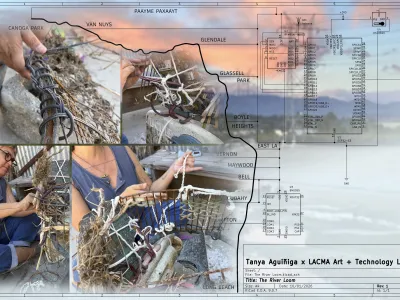
Tanya Aguiñiga
The River Loom
Tanya Aguiñiga will create a network of handwoven sculptural beacons along the Los Angeles River that collect and communicate data about the river’s movement and environmental conditions. Combining traditional craft with sensing and communication technologies, the project will explore the river as an interconnected ecological, cultural, and technological system. Aguiñiga’s project is called The River Loom.
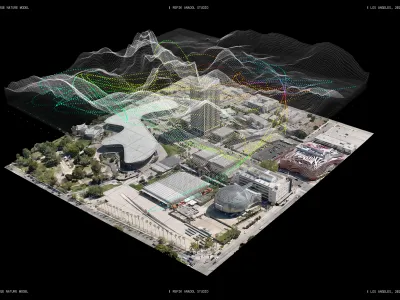
Refik Anadol and Christina Moushoul
Latent Terrain
In a cross-institutional collaboration between DATALAND and LACMA, Refik Anadol and Christina Moushoul will transform the museum’s campus into an interactive soundscape, where visitors’ movements through the grounds generate an evolving composition drawn from recordings of California’s diverse natural environments. Their project, Latent Terrain, runs on the Large Nature Model, an ethical AI system developed at DATALAND.
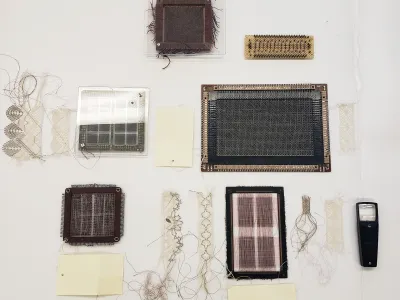
Chloe Bensahel
Neural Networks (Instruments of Darkness)
Chloe Bensahel will investigate the historical and material connections between textile craft and artificial intelligence, exploring how traditional forms of knowledge and making might inform contemporary approaches to machine learning. Through archival research, technical experimentation, and lacemaking, Bensahel will consider the cultural assumptions and biases embedded in ideas of intelligence. Bensahel’s project is called Neural Networks (Instruments of Darkness).
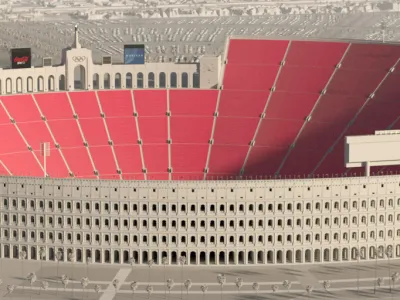
Paul Pfeiffer
Vitruvian Figure (Olympia)
Paul Pfeiffer will use Los Angeles’s preparations for the 2028 Olympic Games as a framework for exploring the technologies and media systems that shape mass spectatorship. Through speculative architectural models that radically expand the scale of two iconic Los Angeles stadiums, as well as observational filmmaking centering the broadcast infrastructures around the games, Pfeiffer will examine the increasingly networked nature of audiences and the contemporary attention economy. Pfeiffer’s project is called Vitruvian Figure (Olympia).
Over the next two years, the recipients will develop their projects in dialogue with LACMA, the Lab’s advisors and partners, and one another. Along the way, audiences will have opportunities to encounter works in progress, experiments, demonstrations, and other aspects of the artists’ research.
The first opportunity to learn more about the new projects will be the Art + Technology Symposium at LACMA in late February 2027. The symposium will bring together the 2026 grant recipients for presentations and other programs offering a closer look at their projects and the ideas, technologies, and questions driving their research.
Stay tuned for additional information about the symposium and updates from the artists as their projects develop.
The Art + Technology Lab is presented by

The Art + Technology Lab is made possible by Snap Inc., and Anthropic.
The Lab is part of a long‑term partnership between Hyundai Motor Company and LACMA that explores the evolving relationship between art and technology.
Image Credits:
Image courtesy of Tanya Aguiñiga, graphic and circuit drawing by Milo Smolin
Refik Anadol and Christina Moushoul, Concept drawing of Latent Terrain, © Refik Anadol Studio
Research at the Smithsonian Museum of American History, 1950s technical woven objects (magnetic core memory,) handmade bobbin lace samples (conductive yarn, linen), © Chloe Bensahel
Paul Pfeiffer, Video still of Vitruvian Figure (Los Angeles Memorial Coliseum), 2026, courtesy of the artist and Perrotin