Ebru Kurbak is performing microgravity and low-gravity investigations of textile production, using these experiments as a basis for greater conversation around the ramifications of space colonization. Kurbak’s project is called Reinventing the Spindle.
Artist's Statement
Reinventing the Spindle: A Giant Leap for My Imagination
When I think back on how this project began, what I remember most is a sense of disbelief mixed into the excitement. I had written the proposal as an almost impossible gesture, with my limited knowledge and access at the time: to bring a spindle and flax fibers into microgravity. Learning that flax was one of the first plants grown in space had sparked my curiosity. I wondered how its fibers might behave in zero gravity, given that earthbound techniques of spinning rely so strongly on Earth’s pull. Still, I felt that the technological spaces I was proposing to enter were not made for me. I had never been a “space geek”—not out of disinterest, but probably because of the assumption that one had to be of a certain background to belong. When the pandemic delayed my planned microgravity flight three times, stretching the wait to three years, I even felt a sense of relief. Looking back, I believe I needed that time to grow into my own idea, transforming not only this project but also the way I think about my own limits.
The microgravity experiment grew out of several connected (re)discoveries during those years. Craft today is often perceived as a traditional way of making, directed toward a specific outcome. But craft tools and techniques are never only instruments of production. They are also investigations of materials, of earthly forces, and sometimes of much more. The spindle, for example, takes fibers from plants or animals and, through a shaft, a weight, and the pull of gravity, turns them into workable threads. It became clear to me that I was not only working with a technology that had enabled string-making thousands of years ago, but also with one of the earliest instruments for exploring gravity itself.
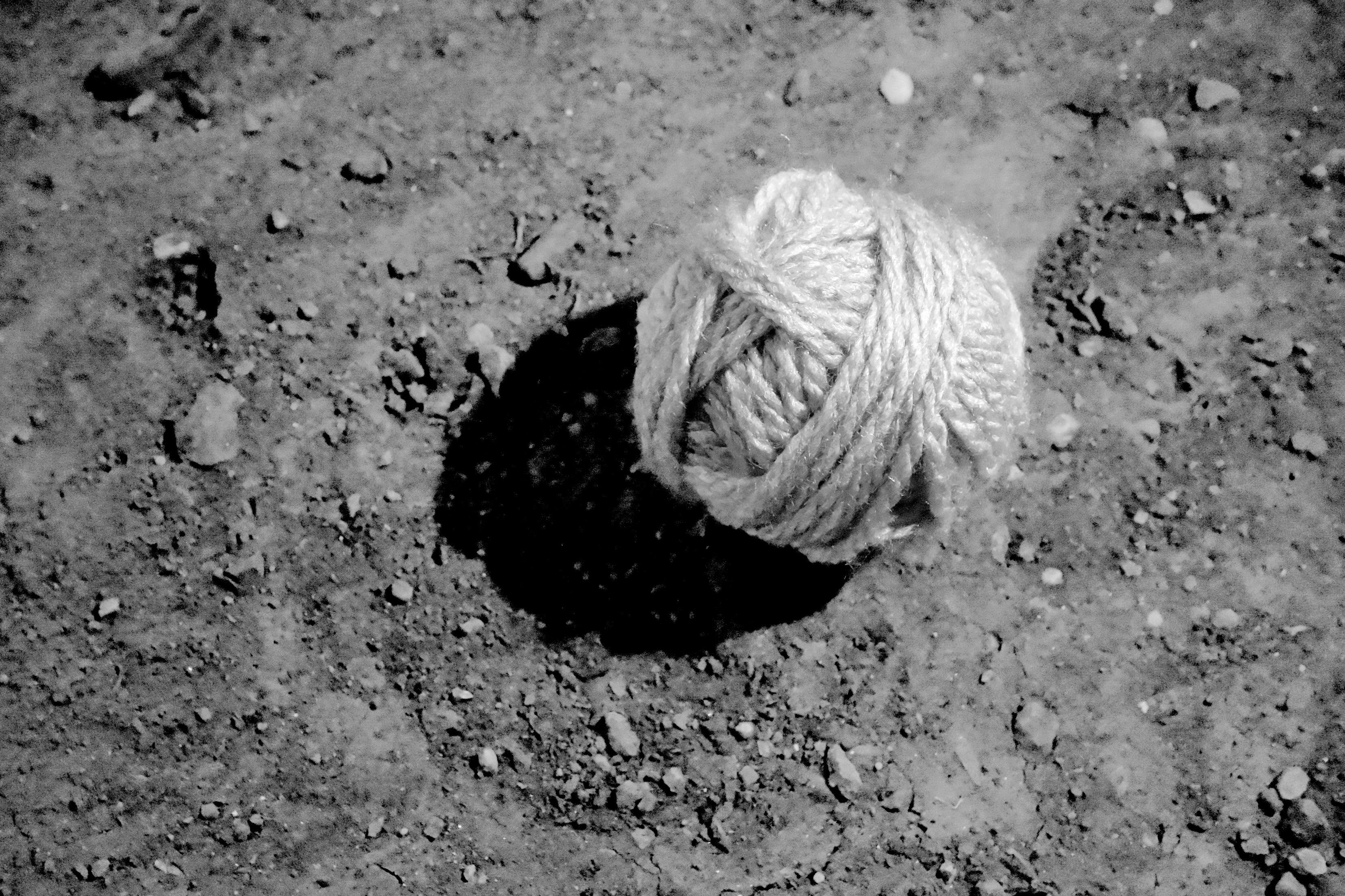
Another strand of thought came when I met Elisabeth Wayland Barber, whose archaeology of women’s work deeply influenced this project. She described acquisitiveness as a settler’s concept, contrasting it with nomadic ways of making that respond only to immediate need. In much of the global north today, materials are usually acquired long before they are needed. When we need a piece of string, we already have a ball of it ready. Barber quotes a Swedish archaeologist in the 1930s describing Chinese camel pullers in Mongolia who would “simply snatch a tuft from a camel shedding its hair and, in a moment, turn it into a piece of string for repairing a pack-saddle or the like, by twining it against the thigh....” This way of working offered me a different compass in designing the experiment. I tried to explore what could be done there, in weightlessness, specific to those circumstances, with almost nothing.
Reinventing the Spindle, in the end, became an interwoven fabric of many histories: the imagination of zero gravity; the development of gravitational physics; the prehistoric technology of the spindle; space botany and materials research in Low Earth Orbit; questions of ownership of exoplanetary and Earth orbits; and even the biographies of people who had traveled to space. Yet the project would not have been what it became without actually going on the parabolic flight, kindly provided by the MIT Space Exploration Initiative, one of LACMA Art + Technology Lab’s partners.
Eventually, I stepped onto the plane. Each parabola gave twenty seconds of weightlessness, and in those brief moments I spun a thread of flax. Fragile, imperfect, but real. That thread not only captured the long research process in its twisted fibers but also carried me from what once felt unimaginable to what became possible, reshaping what I can imagine as work.