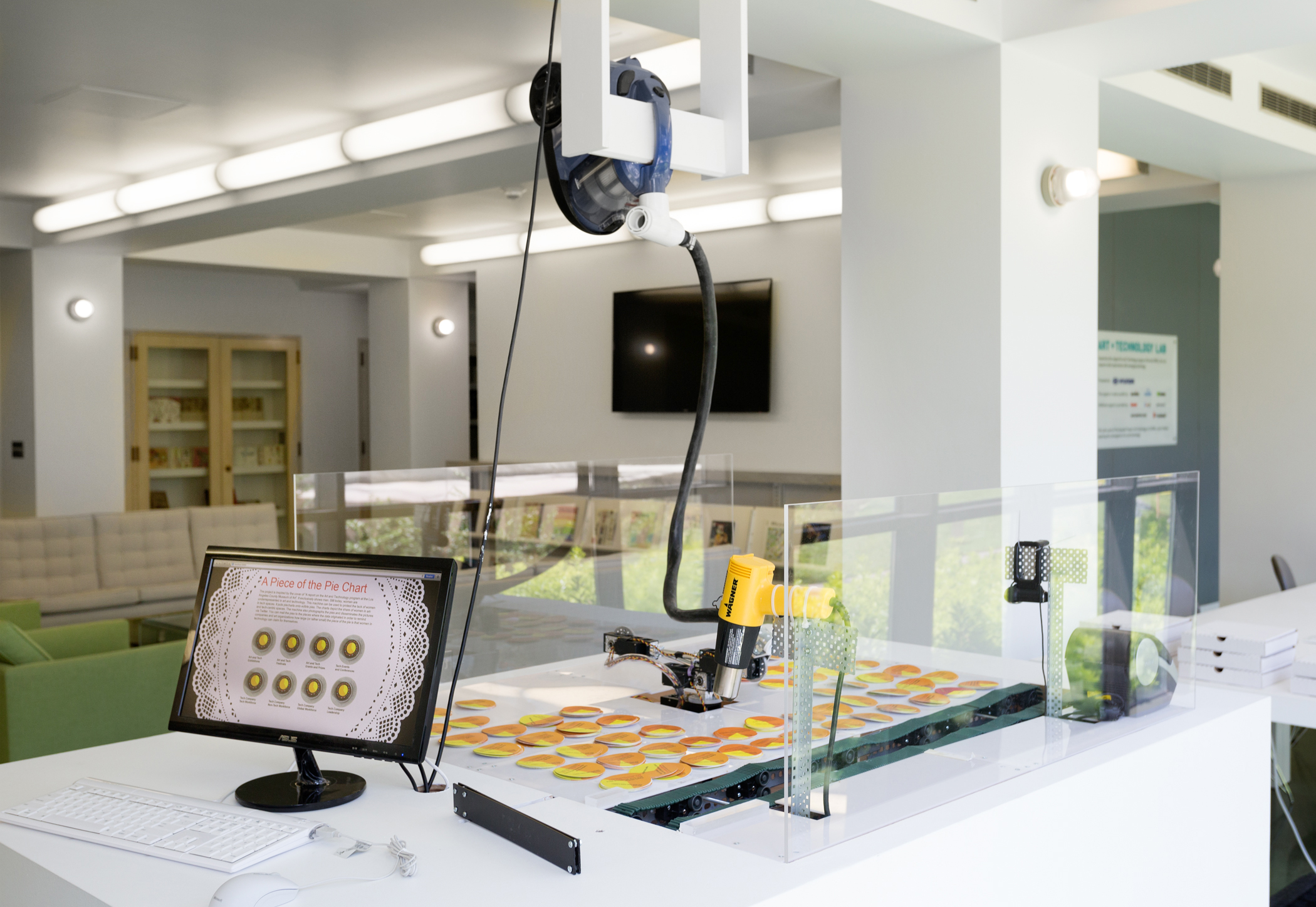
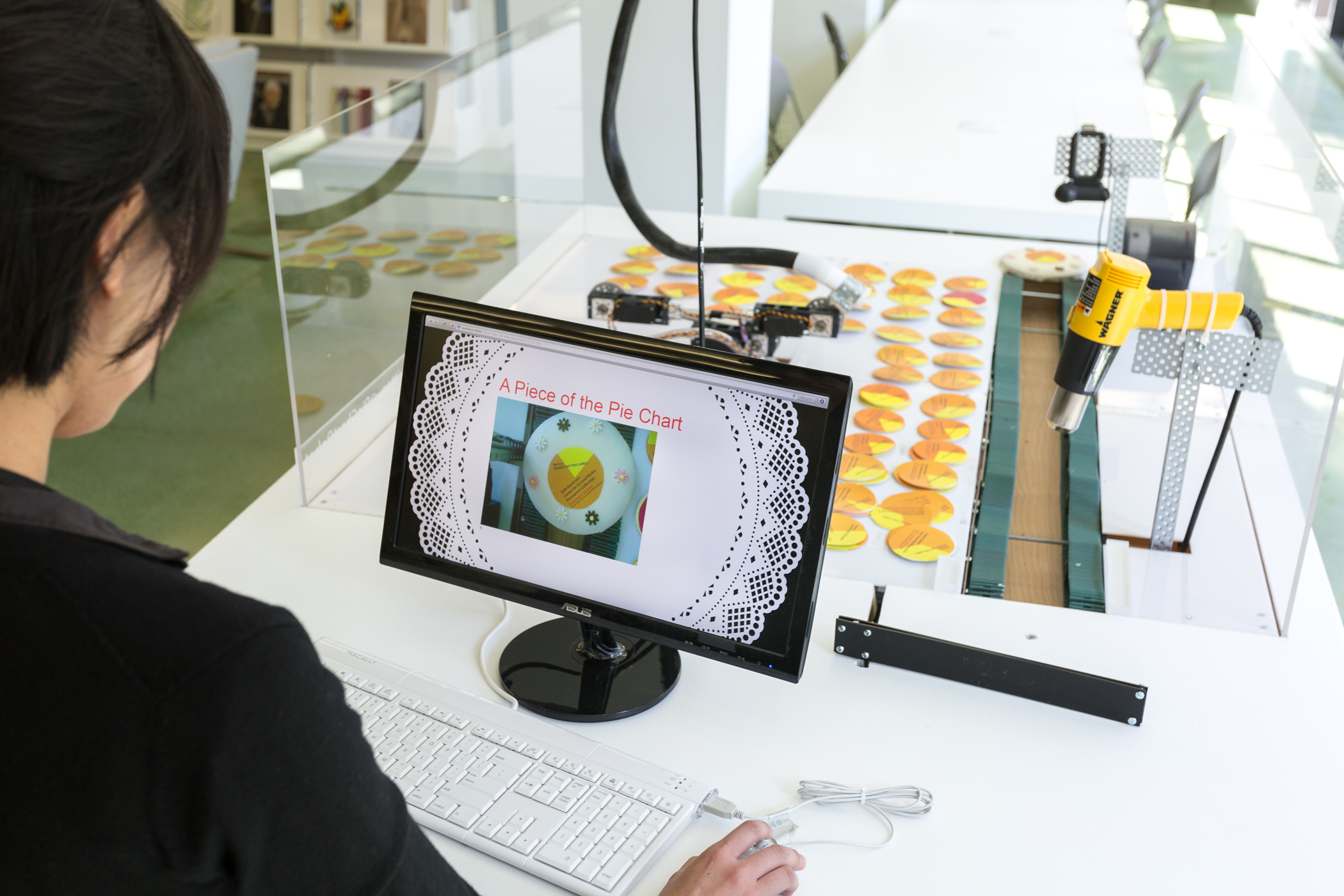
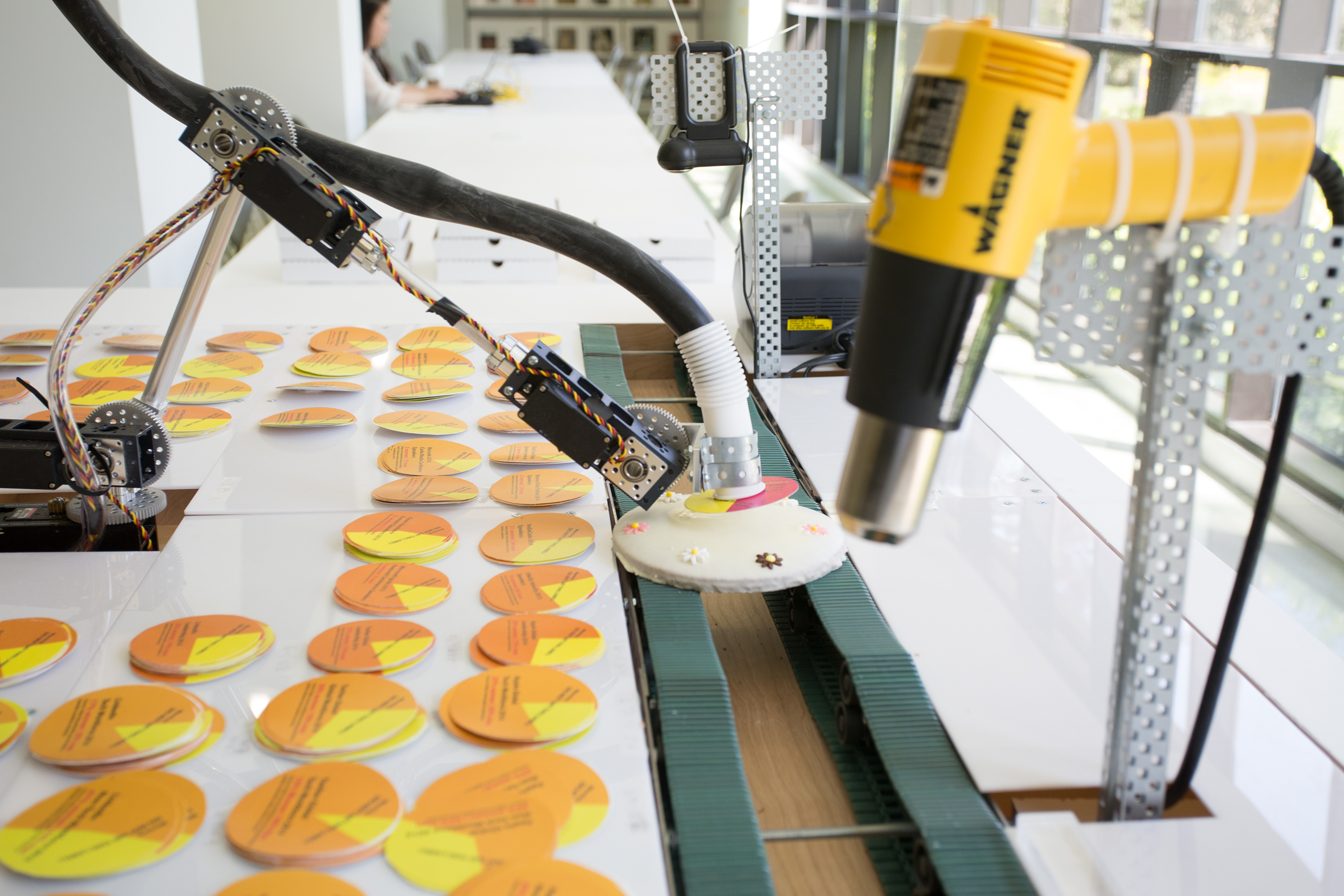
A Piece of the Pie Chart was an interactive food robotics project that put pie charts onto real, edible pies in order to examine gender equity in art and tech. The data on the pie charts depicted gender ratios in places where art and technology work happens (tech companies, museums, galleries, festivals, etc.). It was an edible data visualization that protests the lack of women in these fields.
Artist's Statement
Revisiting the Report: Women + Data in Art + Tech
When I submitted my proposal to the first cycle of Art + Tech Lab, I researched the original LACMA Art and Technology Program. It ran from 1966 to 1971 and was curated by Maurice Tuchman and Jane Livingston. The program was criticized for excluding women and minorities even though many had applied. As a result, it became the subject of feminist protests at the time. One group that protested was the Los Angeles Council of Women Artists (LACWA). On June 15, 1971, they published the “Los Angeles Council of Women Artists Report”. The title references Maurice Tuchman’s 1971 publication “A Report on the Art and Technology Program of the Los Angeles County Museum of Art”. They wrote: “As many women as men enrolled in the art schools of this country, but the number of women who achieve recognition is negligible”. They then go about meticulously collecting gender data on one-person and group exhibitions from 1961 to 1971. They found a single one-person exhibition by a woman (Dorothea Lange) among 52 by men. The percentage of women in group exhibitions at LACMA within the same time span was 4%. LACWA published an appendix of data along with a list of demands as part of their report. They also threatened to sue LACMA but eventually found an agreement with LACMA. As part of the agreement, LACMA committed to hosting the exhibition Women Artists: 1550–1950, curated by Linda Nochlin and Ann Sutherland Harris, which opened in December 1976. In the following, I will briefly describe my project and activities at LACMA and some of the people I met along the way. I will also revisit the LACWA report and its relevance today.
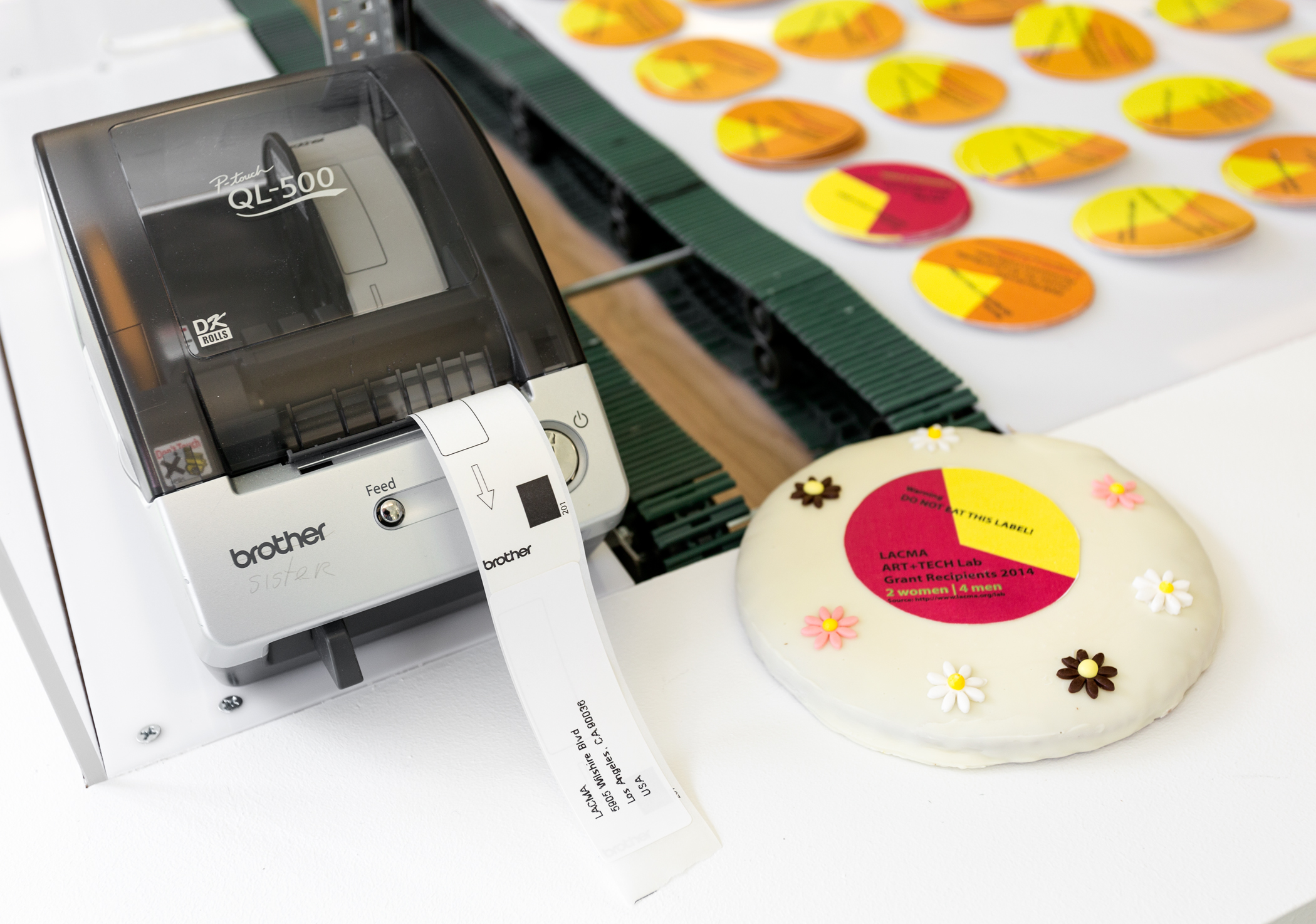
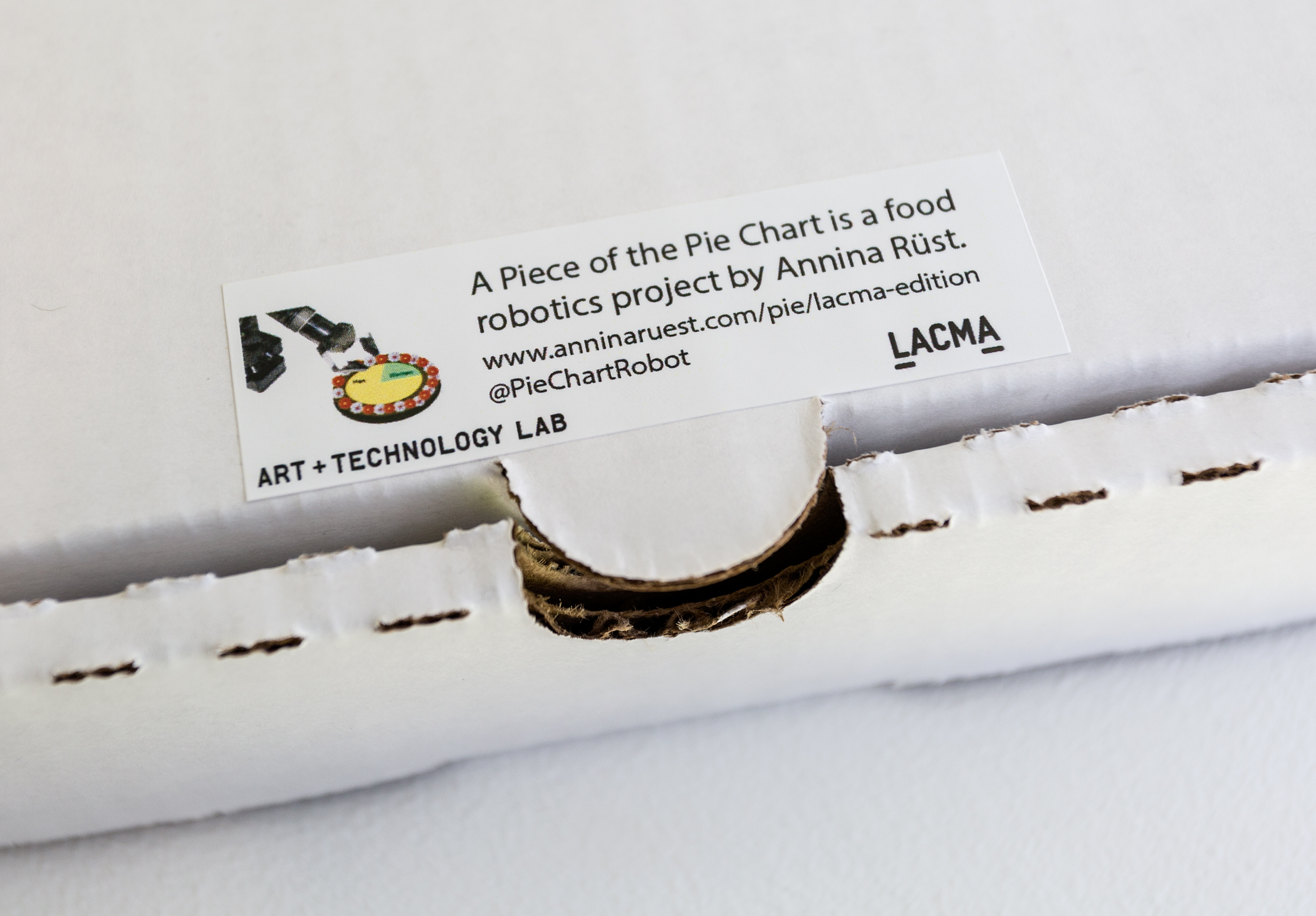
My contribution to the first cycle of Art + Tech Lab running from 2014-15 is A Piece of the Pie Chart, a robotic installation that protests the lack of women in art and technology spaces with data and baked goods. It is a food robot that places pie charts onto real, pre-baked pies. It then takes a picture of the pie and posts it to social media. It also prints an address label that exhibition visitors can use to package and mail the pie to the art and tech venues where the data originated. Besides making the project and installing it at the Art + Tech Lab, I co-hosted two events at LACMA with artist Micol Hebron. She is a feminist artist and the director of the Gallery Tally Poster Project. In Gallery Tally, Hebron crowd sources gender data from top contemporary art galleries and, together with other artists creates posters using the data. These posters are then exhibited. Together, we hosted a workshop on feminist data visualization at LACMA. Among the attendees was Ann Isolde, an artist who was part of the artist group protesting LACMA in the 1970s. She became an impromptu co-facilitator of the workshop, connecting historic feminist protest of the 1970s and 1980s with the present.
A Piece of the Pie Chart, the project I created for LACMA Art + Tech, is the first project in my “Techno Biography” series. Techno Biography is a series of feminist technology works that touch on women’s lives, including mine. Two of these works are on motherhood. The first is the audiovisual performance Good Mother/Bad Mother. This performance features a projection, a breast pump as a sound generator, as well as a wearable LED pumping bra. The performance explores societal perceptions about ideal and non-ideal motherhood and the workplace through sound and projected visuals. The second work is titled Pac-Mom: A game about gender and food insecurity. It is a parody of the classic arcade game Pac-Man. Pac-Man is an eating game, Pac-Mom however is a game that investigates gender, work, and food insecurity. I am currently working on a technology-driven artwork on perimenopause and menopause. This work uses persistence of vision (POV) LED fans. These fans use the POV effect to display moving text or images and will be used to visualize menopause-related data. Commonly used to relieve hot flashes, these fans will also provide a refreshing breeze that the audience can feel.
My grant period at LACMA is now over ten years ago. Over this stretch of time, the United States witnessed a rise in popularity of diversity, equity, and inclusion initiatives from 2020-2022 which were in part prompted by protests following the murder of George Floyd. In 2025, at the time of this writing, these initiatives are being rolled back at many institutions in the US in the wake of the 2024 presidential election. The gender ratio of LACMA Art + Tech over ten years has been 21 women, 28 men, and six non-binary/genderqueer. In the greater art world, gender diversity continues to lag. The authors of The Art Basel and UBS Art Market Report 2025 say the following in the section titled “Representation and Gender”: “Research of the gender distribution of artists represented by galleries has revealed imbalances in the market, with a persistent underrepresentation of female artists”. In corporate tech where women continue to be underrepresented in creator roles, the backlash to diversity, equity and inclusion initiatives has been palpable. In January 2025 Mark Zuckerberg said on The Joe Rogan Experience that corporate culture has become “culturally neutered” and called for more “masculine energy,” arguing that workplaces have leaned too far into feminine traits at the expense of assertiveness and aggression. I recently re-read the LACWA Report and it is clearly assertive, data driven, and focused on getting results. Some would call this “aggressive”. The LACWA report is a document reflecting institutional critique that has not lost relevance. It can serve as a reminder to institutions in art and tech to keep working toward diversity, equity, and inclusion. The artists in LACWA were ahead of their time back in 1971. The document they wrote 54 years ago can still serve as a guiding light to tech companies, art institutions, and to individual artists like me.