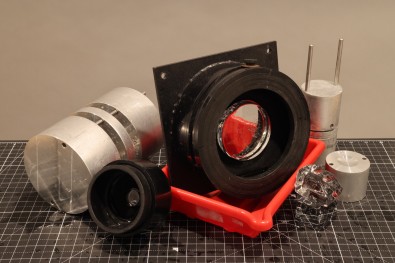
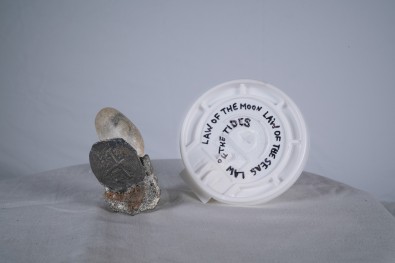
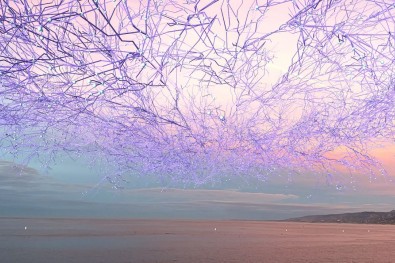
Kovács/O’Doherty developed a project that used satellite technology to create a poetic response to the erratic signals of LES-1, a defunct spacecraft that ceased to function in 1967 but unexpectedly started transmitting again in 2013. Titled Signal Tide, the work was a sound and extraterrestrial radio installation, which combined the satellite’s wavering signal with a special musical score, outside LACMA’s Pavilion for Japanese Art.
Artists's Reflection
Outer Space
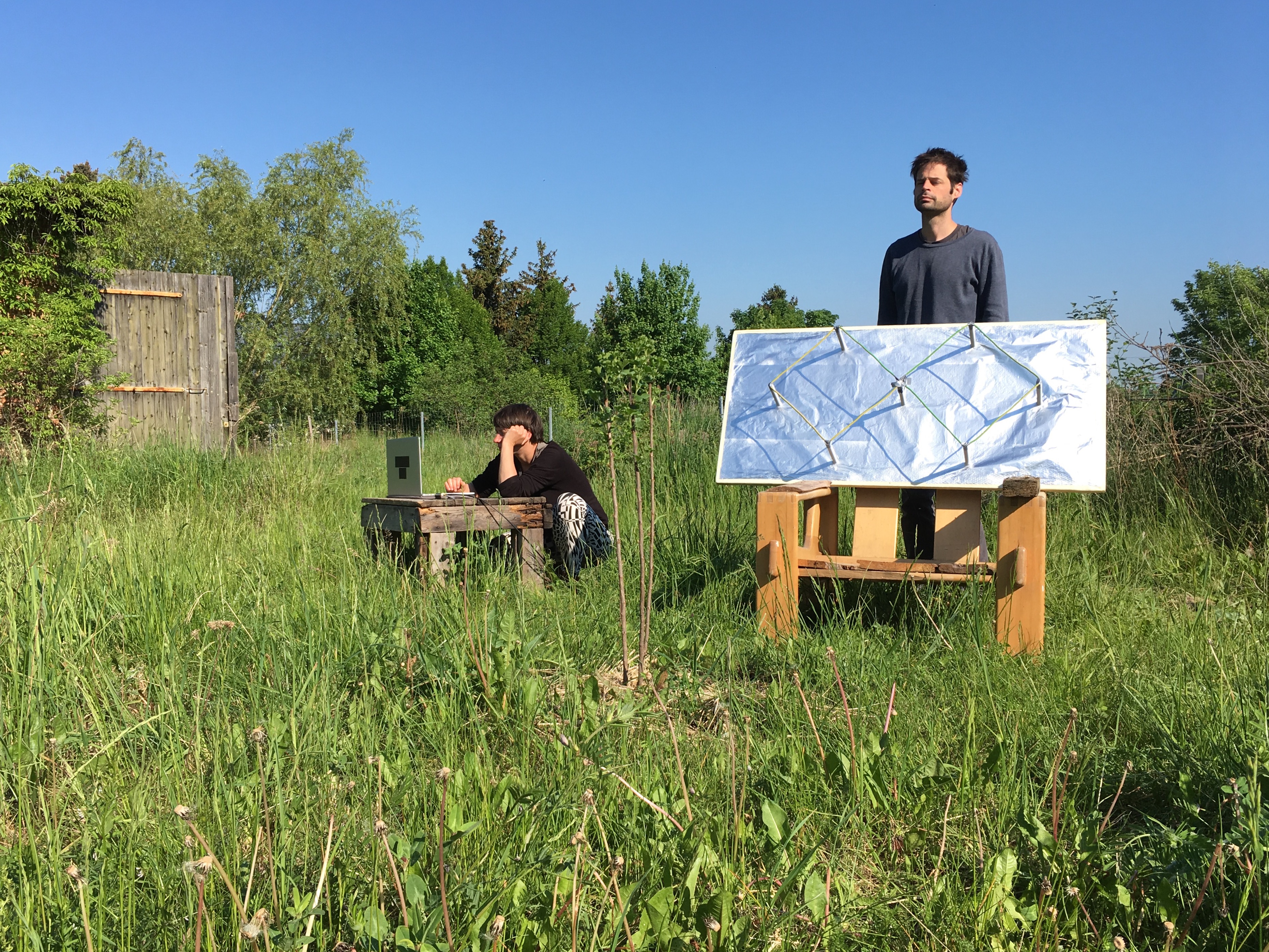
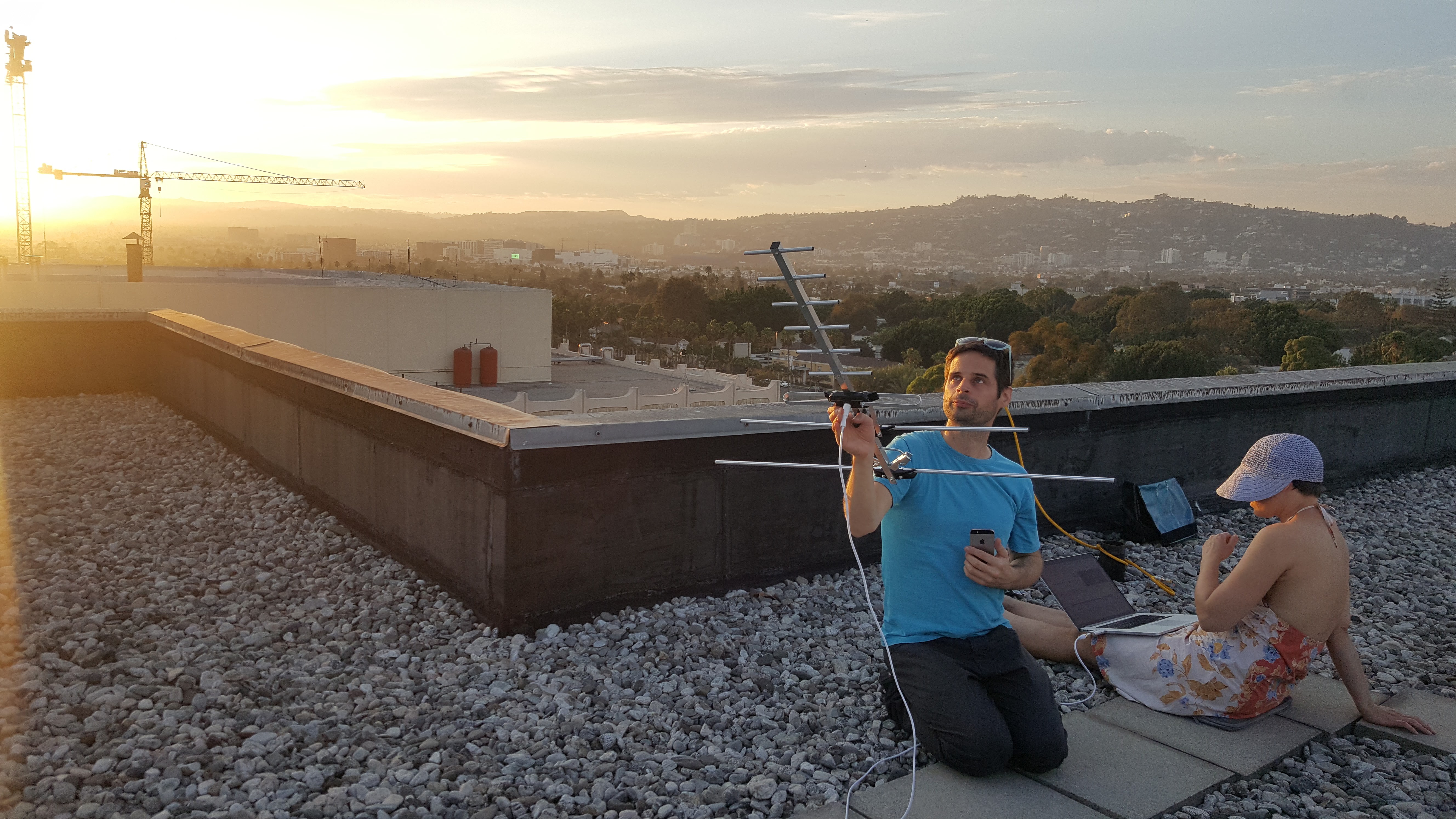
The time that we spent working at the Art + Technology Lab in 2017 was one where we chased after the signals of an abandoned satellite. Specifically, we were attempting to reliably intercept the signals of the LES-1, a satellite that was launched in 1965, and which was abandoned in 1967 as space junk, after ceasing to provide reliable transmissions. At some point in the intervening decades, the LES-1 mysteriously began to transmit signals again. Our project, which we titled Signal Tide, involved combining audio, derived from the live feed of the resurrected satellite’s signal, with a musical ‘answering’ signal, in real time, as the satellite passed overhead.
A few years after our project, we went to see Sun Ra Arkestra, when they played in Berlin in 2022. They were amazing. Afterwards, we talked a little bit about the metaphorical potential of outer space.
Sun Ra spent decades presenting an artistic conception of outer space as a site of collective liberation. A place where exploitation is overcome, where earthly shackles are transcended. This vision is at the core of the delphic space-jazz mythology of the still-active Arkestra.
Critically, this divination of space as an endless horizon of freedom emerged from the material conditions of America in the fifties and sixties. Sun Ra proposed a vision of outer space as a place for an explicitly Black liberation. A dreamscape of justice achieved through Black people teleporting to other planets. (Some necessary context here: we are from Ireland and Hungary; we are white. We are also curious about poetic depictions of outer space.)
Outer space, for Sun Ra, offered transcendental possibilities. However, outer space, in the ideological frameworks of entities like SpaceX or Blue Origin, is a somewhat different proposal. It is a place for combining Star Trek aesthetics with neoliberal economics. Space is the final frontier—but the frontier is simply another place to get rich, a nebulous boundary between the mystery of the unknown and the zone of property rights.
It’s difficult for us to grasp now just how different the stakes were in the early 1960s, when the Arkestra first moved to New York. The space race was advancing at blistering pace, but the future that it portended was very much up for grabs. There were shimmering, nascent promises of a future in the stars, but no guarantee that it would be communist, or bourgeois-capitalist, or something else entirely. The future was being written, and the metaphorical potential was rich. Sun Ra seized on the symbolic possibilities of this amorphous and emergent reality. The Arkestra presented auguries of liberation surpassing our wildest imaginings.
Our work at LACMA also considered the remnants of the space race, and was presented in 2017, which is not that long ago in the grand scheme of things. However, even in the short time since then, the commercialization of space has grown significantly, and problems associated with this have grown alongside it. For example, low-earth-orbit commercial satellites are increasingly ruinous to plenty of practical optical astronomy research.
But there is a more insidious foreclosure here, which is the slow sealing-off of space as a site of liberation and as-yet-unrealized emancipatory possibility, whether practical or poetic.
Sun Ra’s hypnotic vision relied on the idea that space had not been bent to the will of capital. That was self-evident in the 1960s, and was still true up until perhaps a few years ago. Let’s say 2021 or so. But now, we seem to be facing an era when outer space is becoming just another neoliberal extraction zone, where NASA will pay companies to mine the moon, and startups chase asteroids for critical minerals.
When considering the intermingling of art and technology, there is no shortage of emergent fields that will surely prove artistically fruitful, even as they will also surely bring dystopian developments elsewhere—machine learning, humanoid robots, drone swarms, biohacking, many more. The poetics of these fields, their artistic sensibilities, are still forming. But the poetics of outer space that Sun Ra first articulated seem to run the risk of being eclipsed by the political economy of the present.
There is still the possibility that space will triumph over capital, at least for now. Perhaps the costs will be too high, the investments too risky, the returns too unreliable. But the metaphorical possibilities seem to be shrinking. It’s something that seems like it ought to require some kind of elegiac acknowledgement. Space is the place.