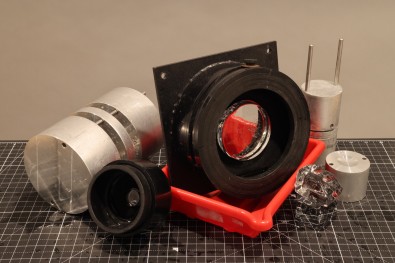
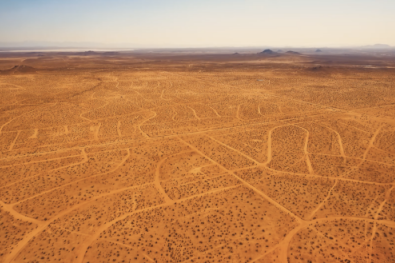
I.R. Bach worked with mirrors, optics, and other surveillance technology to pursue a work that both examines and mimics a mysterious encounter the artist experienced while camping in a mountain range in Mexico. Visitors to LACMA had the opportunity to view a light drawing composed of three points of light emanating from a distant mountain. The project is called I Want to Know.
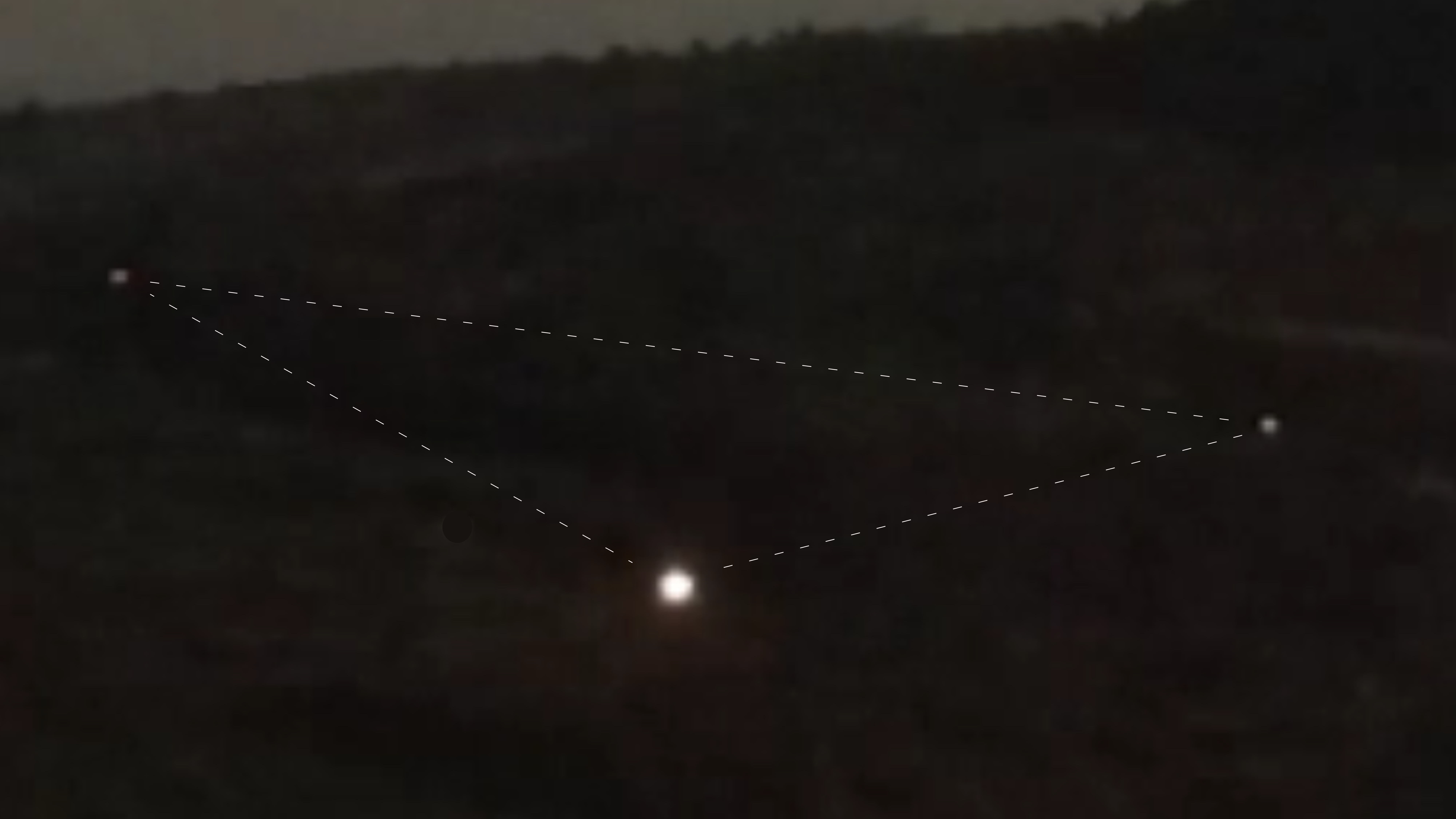
Artist's Statement
Bringing Chronos to life was as much a story of problem-solving as it was of cosmic alignment. From the outset, connecting the sun’s reflection at the Griffith Observatory to the vantage point at the BCAM’s terrace turned out to be a matter of fate.
The first challenge was finding the right surface to reflect sunlight with precision and intensity. Together with the Art + Technology Lab’s curator Joel Ferree we tried out all kinds of materials. We fantasized about motorized heliostats that tracked the sun, played with Mylar balloons and put together fiber glass and aluminum foil contraptions. After several trials we finally settled on the most straightforward but surprisingly effective solution: military-style signaling mirrors used during the second world war to signal airplanes. These mirrors have a window that pin points the target with precision, so volunteers placed in strategic points on the mountain below the observatory could reflect the sun towards LACMA.
Yet even with the right technology, nature—and art—has its own plans. When I first scouted the vantage point on the BCAM terrace, the line of sight to Griffith Observatory was crystal clear. However, when the time came for the performance, a palm tree artwork by John Irving that had been unnoticeable during my initial visit had grown to block the view! It was a humbling moment that prompted us to find a new spot. Then, on the first attempt to perform Chronos, clouds rolled in and masked the sun at the critical moment. All I could do was wait for the second attempt, which succeeded, completing the connection. It was until after-the-fact that Chronos created another alignment, this time autobiographic, as it connected two moments within my own life: Two years after, I moved to Los Angeles and found myself living in Los Feliz, right where the triangle of light had appeared back in 2018. A coincidence since it was my wife who had chosen the site beforehand.
Incredibly, this was not the first time that art and my life predicted each other. There was a symmetric point in time 20 years before, when I was a music composer. After telling a friend about my interest in synchronizing light to my music I received an invitation to make a site-specific art installation at a habitable sculpture from the 1968 Mexico City Olympic Games called the Tower of winds. During the production, I realized that art was my true calling but I also realized that I could see my childhood house from the site and remembered that I used to point my telescope at it, without a clue that, decades later, it would give birth to an art career with my first artwork: Tonos.
My participation at the Art + Tech Lab was to be a closure of sorts. As fate had it, my insatiable curiosity and interest in technology led me to a career shift toward science. The synchronization of light and sound at ultrafast speeds paved the ground towards a technological breakthrough to combat cognitive decline. Chronos heralded a new era for me, just like Tonos marked my passage from music to art two decades earlier. Yet, the equilateral triangle that once connected the Griffith Observatory and LACMA made the jump into science as a flickering light vehicle for people to connect with their own memories.
Looking back, I see Chronos not just as a feat or an omen, but as a reminder that life, no matter how thoughtful its planning, is ultimately shaped by the unpredictable. Trees grow, clouds gather, and sometimes the simplest solutions triumph. And yet, in that moment, when the mirrors caught the sun just right—Chronos became more than a little miracle. Like Keith Jarret’s Memories of tomorrow, Chronos spanned a bridge across life itself; an unpredictable journey full of unexpected alignments.