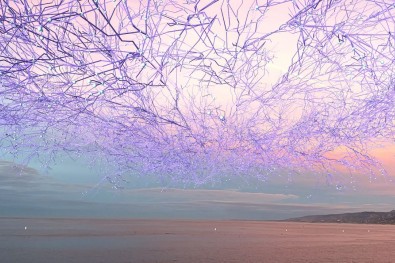
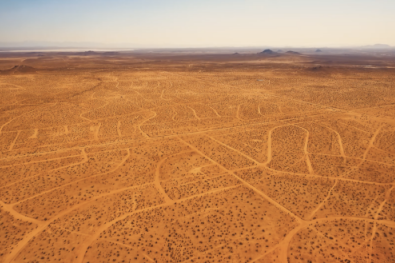
Sarah Rara is researching human navigation and how it is mediated by video images. In addition to working with the Lab’s advisory board, Rara is continuing her work with Caltech’s Dickinson Lab, where her research initially took shape. The project is called Ellipsoid Body, - a reference to a ring-shaped brain structure within fruit flies that is needed for navigation.
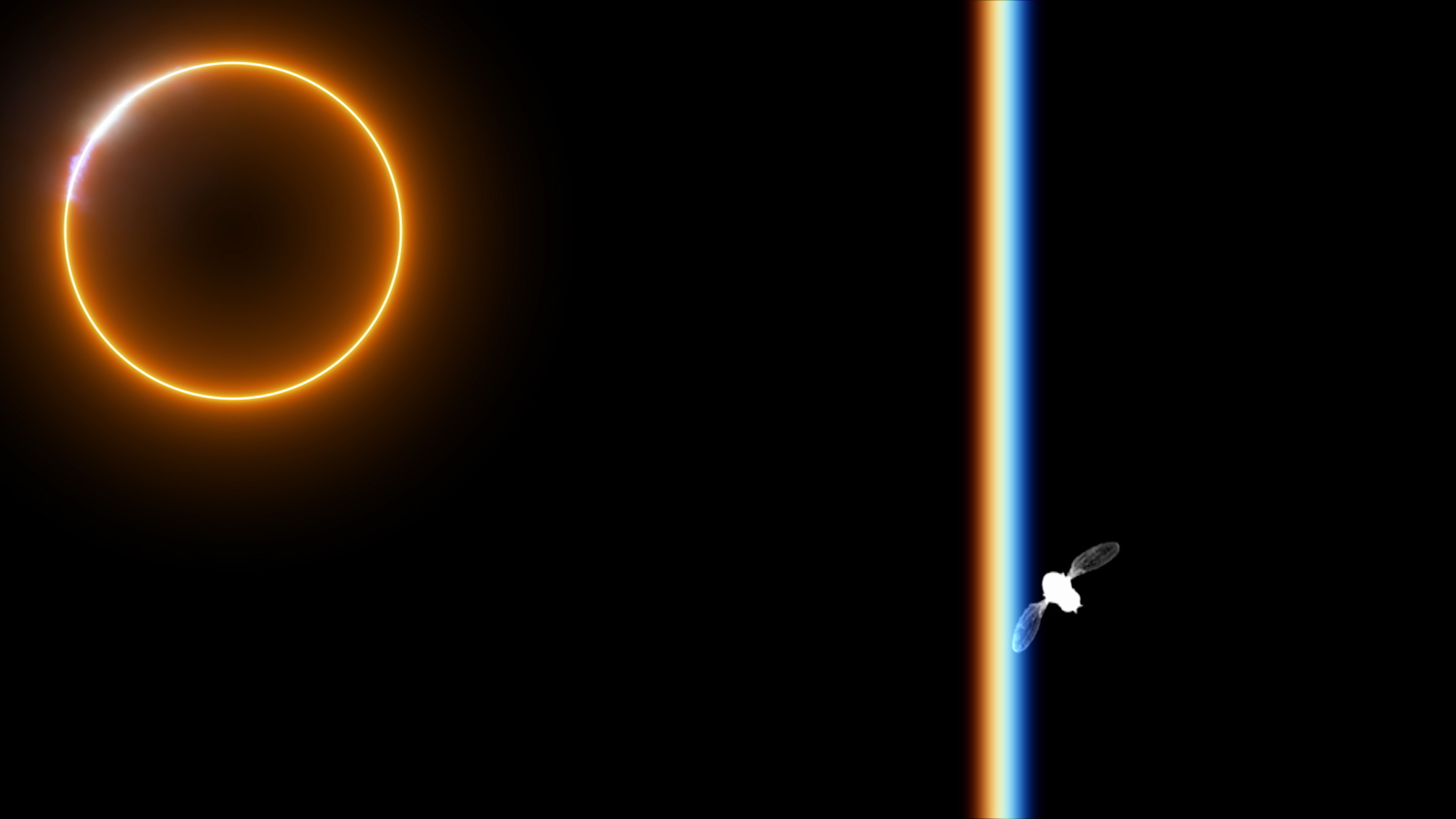
Artist's Statement
Ellipsoid Body takes many turns, a project in process for close to ten years now. It remains a project in motion—a project about movement and navigation. Ellipsoid Body takes the form of an intentional meander, finding positions from which to ask: How do we orient ourselves? How do we know where we are and where we are going? What role does video play in determining our spatial and temporal coordinates? Video is inherently unruly, multi-dimensional—a tool for generating views of current, past, and future positions. The inquiry invariably opens up and changes direction, linked to case studies around navigation and movement. Video merges multiple timelines, coordinates, and information streams. It functions as a tool for navigation as well as simulation.
I want to understand how, amidst so many streams rich in spatial and temporal information, one forms an orientation or takes a position. At Caltech’s Dickinson Lab, I observed how fruit flies navigate virtual space, flying in relation to video images that simulate the position of the sun. At JPL, I spoke with NASA scientists who remotely navigated a vehicle with an ion engine into orbit around a dwarf planet in the asteroid belt between Mars and Jupiter. I studied videos designed for use in medical contexts, for subjects experiencing vestibular disability. The vestibular system controls embodied sense of balance and tilt, as well as image stabilization, linking the inner ear and the eye. In treatment, patients practice specific head and eye movements while navigating two-dimensional mazes, or walk toward video images of stripes and flashing black and white patterns—similar to the videos shown to fruit flies in the lab. I spoke to practitioners of celestial navigation techniques who traverse the open ocean, where there is no land visible. I travelled across the Arctic Ocean to approach the North Pole via an ice-crusher ship, observing how radio and radar technologies interact with sea ice and electro-magnetic solar storms. Each unfolding case study establishes further rich connections between computer-sensing and embodied-sensing of movement, orientation, and place.
In the lab, I peered inside a fly, to see how it worked. Such things can happen. Observing as an artist, not a scientist, I feel at home in the lab, another kind of studio. We should talk more, artists and scientists: highly trained observers, critics of reality. Each drawn to the kinds of questions that take generations of work to answer, to build upon. Work that never ceases, wide-ranging, infinitely surprising. The frisson of each small discovery based on close observation. Inquiries conducted in search of the moments when one is left speechless. There is nothing else to say, because the language has not been invented yet, we are inventing it.
The fruit fly experiments take place in small virtual reality theaters, table-top rings of LED video screens where tethered flies react to video. Sometimes the fly controls the video display, as in a video game. Cameras and sensors map the image to wing movements of the fly. As the fly “turns,” the video image turns, or rather the fly senses they are turning, because the video image turns. The fly is fixed in place, but perceives itself in motion. Video can do that, re-orient a subject, produce a sensation of motion, of space. In a configuration that astounds, researchers are able to peer in real-time at the activity of genetically-modified neurons marked by fluorescent proteins. Active neurons fluoresce as the fly turns toward the image, as the fly alters its wing movements. As a fruit fly flies, neurological activity flashes across a handlebar-like structure called the proto-cerebral bridge that is linked to navigation and movement. The proto-cerebral bridge is connected to a ring-like, symmetrical structure, the Ellipsoid Body. Neurological activity in the Ellipsoid Body lights up and rotates in correspondence to the direction of a fly’s movement, an elegant mirroring of navigation. An ellipsoid shape with interlacing segments that relate right and left sides of the bridge, alternating with precise and systematic geometry. Something unfathomably elegant underlies the navigation and movement of the insect body in space. The structure is simultaneously wild, alive, and also machine-like. The effect of seeing a fly’s orientation mapped cleanly onto a ring of neurons, like a compass or steering wheel–was, for me, not unlike that of certain artworks that have haunted me since first encounter—objects that feel impossible, loaded with meaning, but also transparent. The information is all there, generously laid out for the viewer, yet still contains a profound mystery that rewards continued observation. An unfurling.
Video for an animal audience: the videos used in the lab’s display contain high contrast stripes, star-field patterns, and bright discs. Video sequences begin with bright stripes sliding across dark backgrounds, because one of the most reliable fruit fly behaviors is “stripe-fixation.” While flying in closed-loop conditions—a tethered fruit fly vigorously orients toward a vertical stripe. If there’s a stripe they will turn toward it, fixing on it, a reflex so strong it is somewhat difficult to explain how flies ever make forward progress through a visual landscape. How do they get anywhere, since the world is full of vertical lines, stripes, highlights, reflections? We are not alike, our bodies configured with very different arrangements of sensors. But I also wonder how I ever progress through virtual or physical space myself, with the wealth of visual information and vertical lines that populate my visual field.
For the fruit fly in the lab, videos are not a simulation of reality—their reality includes video, without brackets or quotations. Images can be as real as physical objects in space—in this context, there is no distinguishing between virtual and physical, as an image of the sun and the sun itself produce similar responses. Representation vanishes. Fruit flies automatically demonstrate something about the overlap between reality and video that took me years to articulate: the flow of images moves in two directions. Video modulates reality, reality modulates video, and our response to either kind of stimulus is physical, sensory, embodied.
While the fruit fly formed the starting point, Ellipsoid Body continues, agile and in motion. To study navigation is to study how we progress through forms of knowledge, how a question travels, and how it arrives.