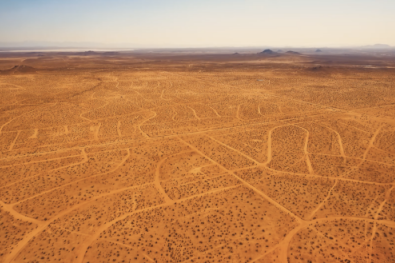
Sarah Rosalena Brady is working with machine learning, coded language, and the loom to develop a performance of technological reformation based upon feminist and decolonial principles. Within this framework, the artist continues to research an indigenous design called a spirit line, a pathway designed to materialize and release weavers from the objects they create. Each woven form speculates possible narratives using the body and machine as memory. Rosalena's project is titled Exit Points.
Artist's Statement
Exit Points received the LACMA Art + Technology Lab Grant in 2019, emerging from my research in digital weaving and textiles. The project emerged from the desire to interrogate artificial intelligence not as a tool of innovation, but as a continuation of colonial systems of extraction, erasure, and control. Supported by LACMA’s Art + Tech Lab, I began experimenting with artificial intelligence (AI) and satellite data, not to showcase machine learning’s potential, but to expose its failures—its noise, biases, and distortions. My early experiments with machine learning models such as generative adversarial networks (GANs) and convolutional neural networks (CNNs) were conducted between 2017 and 2020, before the widespread commercialization of generative AI. Prior to these generative AI models, I was interested in using AI as a site for material thinking: a way to interface with algorithmic systems while remaining attentive to their architectures of bias, omission, and control.
The release of generative AI platforms like those from OpenAI in 2022 marked a significant shift without consent, flattening visual culture into homogeneity. I watched how these systems simply did not produce, but reproduce and amplify the very systems of colonial extraction, intellectual dispossession, and ecological harm that my work attempted to challenge—one that extracts labor, scrapes culture, and consumes vast energy, all without consent, while reinforcing existing structures of power under the guise of innovation. In response, I began using AI-generated images not as ends in themselves, but as patterns for weaving—transforming them through material resistance. Where digital image-making erases its processes in favor of smooth resolution, the woven surface insists on showing its warp and weft–revealing what the screen conceals: the conditions of its own making.
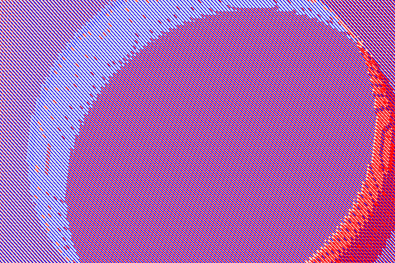
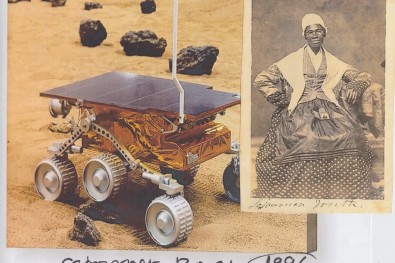
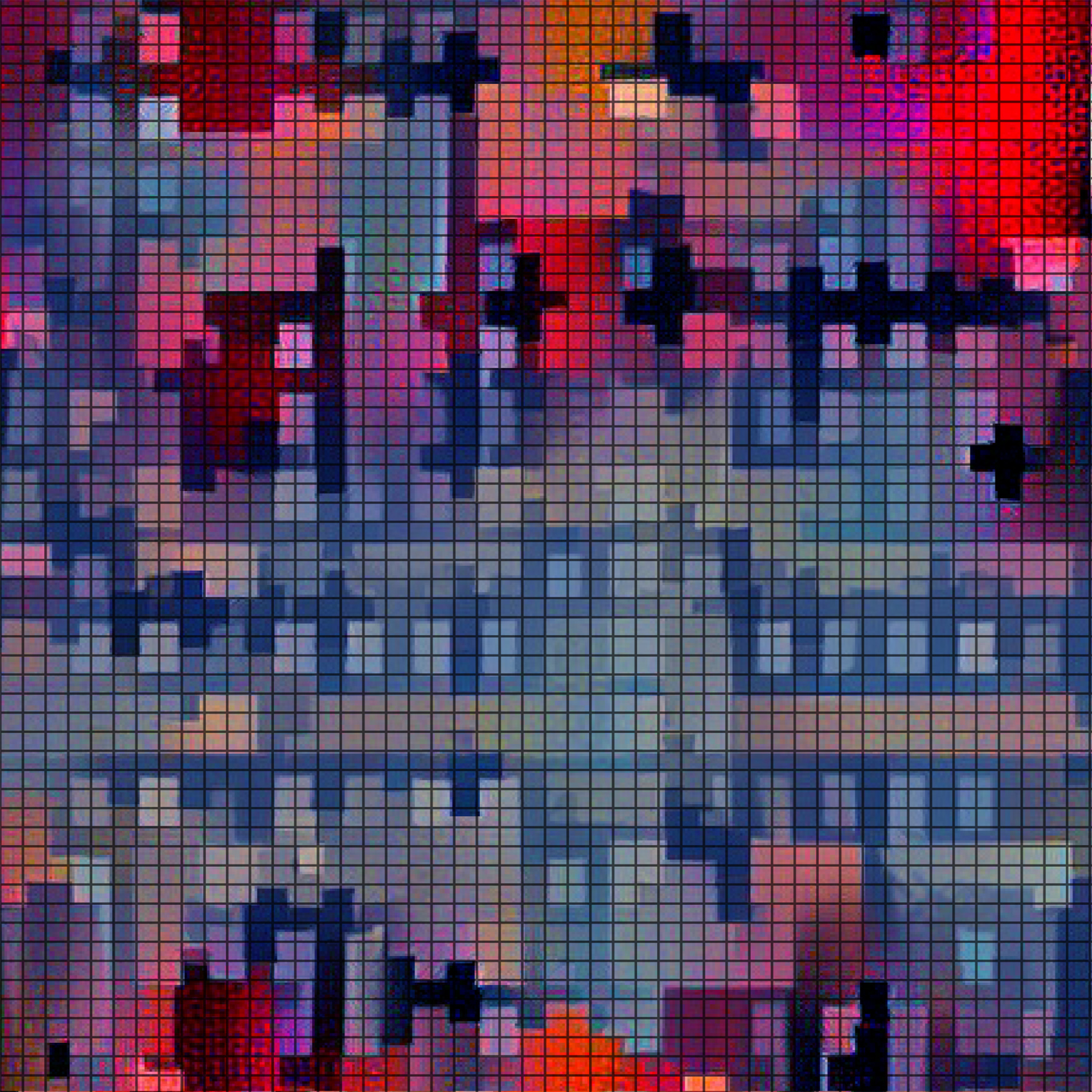
My interest in AI stems from its operation within colonial frameworks of conquest and expansion, both on Earth and at the planetary scale. In 2019, I worked with researchers at NASA’s Jet Propulsion Laboratory to develop Above Below, a series of AI-generated, double-sided Jacquard textiles. Each piece was woven at a scale of one pixel per thread, using neural networks trained on satellite imagery from the Mars Reconnaissance Orbiter. Rendered in shifting fields of red and blue, these works materialize the pixel while challenging the colonial infrastructure of planetary mapping and terraforming. Above Below not only materializes the pixel, but challenges the very infrastructure of place-making tethered to colonial exploration. Alongside these textiles, I produced Transposing a Form, a series of 3D-printed ceramics made from Martian regolith simulant, a faux earth material based on the surface of Mars. Inspired by coiled basket patterns, their open, funnel-like structures evoke black holes as anti-vessels—forms where space, time, and order collapse. Here, weaving does not merely depict space; it constructs it. In doing so, I critically examine how technologies of rendering, resolution, and pixelation shape planetary imaginaries and histories of dispossession.
Weaving became a critical strategy in this transformation—a tactile counterpoint to data abstraction. Each textile rendered the instability of AI systems in physical form: frayed edges, pixelated distortions, gradients bleeding across warp and weft. In my hands, resolution—a central function of image processing—fails on purpose.
This exploration continued in Standard Candle, my solo exhibition with LACMA Art + Tech Lab at Mount Wilson Observatory in 2023, created in collaboration with Carnegie Observatories and LACMA. Installed in the darkened chamber of the 100-inch Hooker telescope, the exhibition reflected on how resolution—both optical and conceptual—renders the cosmos visible. Here, resolution becomes a measure not only of image clarity but also of the resolution of space. The darkness at Mount Wilson Observatory, essential for early astronomical imaging, was made possible by unceded Indigenous Tongva land. Installed within the darkened chamber of the historic 100-inch Hooker telescope, the exhibition engaged with another system of power and invisibility: the labor of early female “computers.” These women, often working underpaid and uncredited, were responsible for cataloguing astronomical data by hand, using glass plate negatives and mathematical calculations to measure the universe. Their contributions laid the groundwork for astrophysics and mapping the universe, yet they were consistently erased from the scientific narrative.
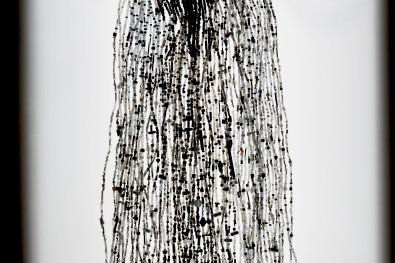
In Standard Candle, I reclaimed this silenced labor by weaving the very images captured by the 100-inch telescope. Each textile was generated from coded interpretations of astronomical data, then beaded and woven into dark, radiant surfaces that evoke the night sky while referencing the hands that once measured it. Installed within the telescope’s black box interior, the exhibition was intentionally disorienting—a space of observation turned inward, toward the labor behind the lens. Weaving here becomes not only an act of translation, but of recognition: a way to trace the invisible architectures of both textiles and science, and to make visible the deep interconnection between gender, technology, and extraction. This sense of rupture, refusal, and reorientation was echoed in the critical essay by Elizabeth Povinelli, written in response to Standard Candle’s use of blackness—black thread, black holes, black boxes—not as voids, but as spaces of abundant, relational knowledge. The glitch in my textiles is not failure, but a presence—an iteration of Coyote, of survival, of refusal. These works offer not escape, but portals into a world configured by relation, not domination.
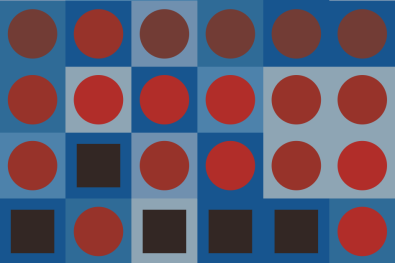
Weaving, for me, is not just a method—it is a proposition. It resists flatness, both visually and epistemologically. Unlike the seamlessness of the screen, woven textiles carry depth, friction, and time. Each thread bears the memory of its making. Exit Points speaks directly to this logic of rupture–pixel per thread. Weaving on the loom is an active technology of resistance. Frayed edges, blurred pixels, unstable gradients—these are not errors to be corrected, but ruptures to be amplified. Each textile becomes a “disruptive terrain,” where threads refuse alignment, colors resist containment, and resolution collapses.
This idea of the terrain—both material and conceptual—is critical to my practice. I understand weaving itself as a terrain: a surface where systems are constructed, challenged, and unraveled. The woven grid mimics what software is made from—not in perfect resolution, not as command, but in the places it falls apart. In those gaps, something else becomes possible.